Introduction
Crypto storage infrastructure is becoming more complex.
A modern environment may include regional storage nodes, encrypted transfer channels, backup queues, access-control systems, exchange API configurations and account activity records. As these systems expand, manual monitoring alone becomes less effective.
Artificial intelligence can help infrastructure teams identify unusual behavior, forecast capacity needs and prioritize technical alerts. However, AI monitoring should not be treated as a replacement for encryption, authentication or human security review.
Its role is to improve visibility and support faster operational decisions.
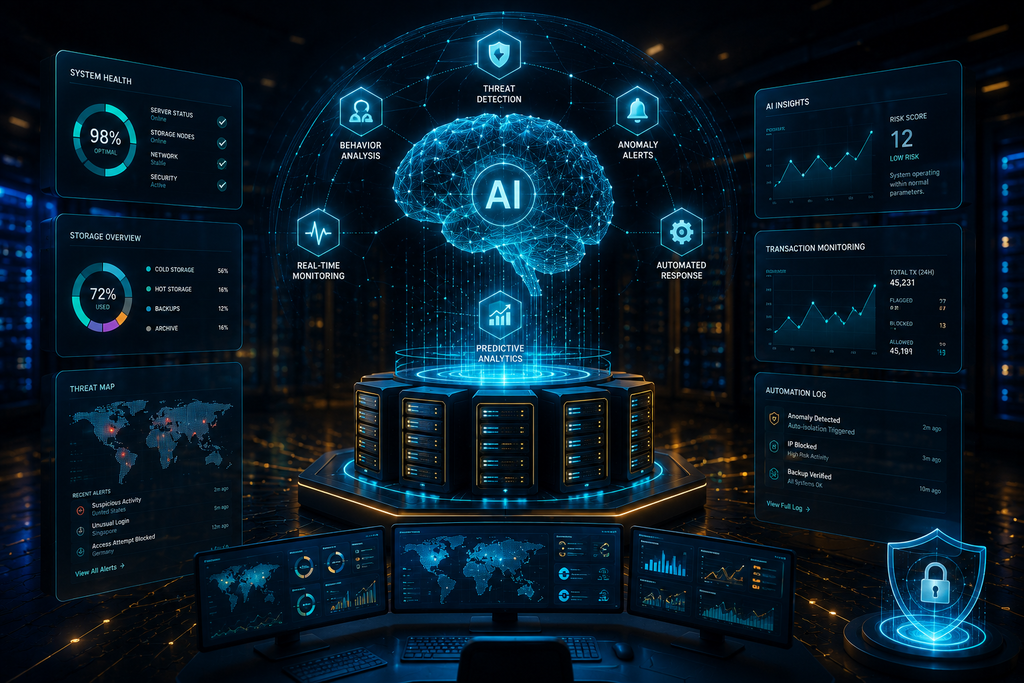
This article explains how AI monitoring systems can be used inside modern crypto storage infrastructure, which problems they can help solve and where their limitations remain.
Why Traditional Infrastructure Monitoring Is No Longer Enough
Basic monitoring systems usually track individual technical indicators.
These may include:
- server availability;
- storage capacity;
- processor load;
- network latency;
- failed login attempts;
- backup completion.
Each metric can be useful on its own. The challenge appears when infrastructure grows across multiple regions and services.
A technical team may need to analyze:
- thousands of access events;
- several storage clusters;
- different backup schedules;
- regional capacity changes;
- unusual data-transfer patterns;
- configuration updates.
Traditional monitoring can generate large numbers of alerts without explaining which events are genuinely important.
AI-assisted monitoring can help connect related signals and identify patterns that may be difficult to detect through isolated rules.
What AI Monitoring Means in Crypto Storage
AI monitoring refers to the use of machine learning, statistical models or automated analysis to review infrastructure behavior.
In a crypto storage environment, the system may analyze:
- authentication activity;
- storage growth;
- transfer volumes;
- backup delays;
- account behavior;
- regional load;
- infrastructure health.
The objective is not to allow AI to control cryptocurrency assets.
The objective is to improve the operation of the infrastructure that protects approved crypto-related data.
Examples of stored information may include:
- encrypted wallet backups;
- keystore files;
- recovery archives;
- API configuration records;
- access documentation;
- business security procedures.
AI Monitoring and Rule-Based Monitoring Are Different
Rule-based systems respond to predefined conditions.
For example:
- alert when storage usage exceeds 80%;
- block access after five failed login attempts;
- notify the team when a backup fails;
- flag a connection from an unapproved IP address.
These rules are predictable and easy to audit.
AI-assisted systems work differently. They can analyze normal behavior over time and identify activity that does not match established patterns.
| Monitoring Type | Main Strength | Limitation |
|---|---|---|
| Rule-based monitoring | Clear and predictable decisions | May miss unknown patterns |
| AI-assisted monitoring | Can identify unusual behavior | May generate false positives |
| Human review | Provides context and judgement | Slower at large scale |
| Combined model | Balances speed and oversight | Requires careful configuration |
The strongest approach combines all three methods.
Detecting Unusual Access Activity
Authentication data can reveal early signs of account compromise.
An AI monitoring system may compare a current login with normal account behavior.
It can analyze:
- usual login time;
- known device type;
- expected IP range;
- geographic location;
- session duration;
- number of failed attempts.
A single unusual event may not be dangerous.
For example, a user may be travelling or using a new device.
The system becomes more useful when several unusual signals appear together.
Example:
- login from a new country;
- new device;
- repeated failed authentication;
- immediate attempt to change access settings.
This combination may receive a higher risk score than any individual event.
Monitoring Storage Capacity
Storage growth is rarely completely predictable.
Users may upload:
- larger wallet archives;
- additional API records;
- compliance documentation;
- new backup versions;
- migration packages.
AI-assisted capacity monitoring can analyze historical growth and estimate when a storage cluster may require expansion.
A basic prediction model may consider:
- average daily growth;
- seasonal usage changes;
- number of active accounts;
- backup frequency;
- replication requirements.
This helps infrastructure teams plan capacity before service performance is affected.
Backup Queue Analysis
Backups can be delayed for several reasons.
Possible causes include:
- high regional load;
- large archive uploads;
- temporary network problems;
- failed integrity checks;
- insufficient capacity.
Traditional systems may only report that a backup is late.
AI-assisted monitoring can compare the delay with previous patterns and help identify the likely cause.
For example:
| Observed Condition | Possible Interpretation |
|---|---|
| One delayed backup | Account-specific issue |
| Many delays in one region | Regional infrastructure problem |
| Delays after large uploads | Capacity pressure |
| Repeated integrity failures | Archive or transfer issue |
This allows support teams to investigate the most relevant area first.
Regional Load Balancing
Crypto storage infrastructure may operate across several regions.
Different regions can experience different levels of demand.
AI models can help analyze:
- storage utilization;
- network traffic;
- transfer latency;
- backup queues;
- available capacity.
The system may recommend moving new account activations toward regions with more available resources.
This does not mean that customer data should be moved automatically without approval.
Regional migration can involve security, operational and legal considerations.
AI should support planning, while final decisions remain controlled.
API Configuration Monitoring
Exchange API configurations are sensitive because they may control access to account information or trading functions.
Monitoring systems can review:
- creation of new API records;
- permission changes;
- IP restriction updates;
- key rotation activity;
- unusual API-related file access.
A risk-based model may assign higher importance to certain changes.
For example:
- enabling withdrawal permissions;
- removing IP restrictions;
- accessing API records from an unknown device;
- changing several keys within a short period.
AI can help identify these patterns faster, but it should not assume that every change is malicious.
Predictive Maintenance
Infrastructure failures are often preceded by warning signs.
These may include:
- increasing error rates;
- slower transfer times;
- abnormal storage response;
- repeated hardware warnings;
- unstable network performance.
Predictive maintenance models can analyze these signals and estimate when infrastructure requires attention.
This can help technical teams schedule maintenance before a critical failure occurs.
The benefits may include:
- reduced downtime;
- fewer emergency interventions;
- better maintenance planning;
- more stable backup operations.
AI-Assisted Security Alert Prioritization
Security teams may receive many alerts every day.
Not all alerts have the same importance.
AI systems can group events and assign a risk level based on:
- number of affected accounts;
- type of access;
- infrastructure region;
- user behavior;
- sensitivity of the accessed data;
- previous account history.
Example priority levels:
| Priority | Example |
|---|---|
| Low | Login from a known device at an unusual time |
| Normal | Several failed logins followed by successful MFA |
| High | New device and changed access permissions |
| Critical | Suspected unauthorized access to recovery archives |
The final priority should still be reviewed by a qualified person when sensitive data is involved.
AI Monitoring for Business Accounts
Business and enterprise users require more structured monitoring than personal accounts.
A company may need visibility into:
- employee access;
- permission changes;
- regional backups;
- archive retrieval;
- support tickets;
- security incidents.
AI can help identify unusual differences between departments or users.
For example:
A finance employee who normally reads reporting archives may suddenly attempt to access technical API configuration files.
This does not automatically prove malicious intent, but it may justify additional verification.
Privacy Considerations
Monitoring systems must balance visibility with privacy.
Collecting more data does not automatically create better security.
A responsible monitoring model should define:
- which events are collected;
- why they are collected;
- how long records are retained;
- who can review them;
- how they are protected.
Sensitive information should not be exposed unnecessarily.
Monitoring should focus on operational events rather than inspecting encrypted archive contents.
False Positives
AI monitoring systems can make mistakes.
A false positive occurs when normal activity is incorrectly classified as suspicious.
Common examples include:
- travel;
- new office networks;
- device replacement;
- unusual working hours;
- planned bulk uploads;
- regional migration.
Too many false positives can create alert fatigue.
Technical teams may begin ignoring warnings if most alerts are not relevant.
To reduce this problem, systems should use:
- account context;
- risk thresholds;
- user confirmation;
- human review;
- regular model adjustment.
Explainability Matters
A security alert should not only say that activity is unusual.
It should explain why.
A useful alert may include:
- new geographic region;
- unknown device;
- unusual access time;
- change in permissions;
- abnormal transfer volume.
This information allows technical teams to make a faster and more informed decision.
Black-box scoring without explanation is less useful in high-security environments.
AI Should Not Control Private Keys
AI monitoring systems do not need access to private keys, seed phrases or decryption credentials.
Their role should remain focused on infrastructure metadata and operational events.
Examples include:
- login events;
- transfer status;
- capacity;
- backup timing;
- permission changes.
Private recovery information should remain encrypted and separated from monitoring systems.
Human Oversight Remains Essential
AI can analyze large amounts of data quickly, but it lacks full business and user context.
A system may identify an unusual event but cannot always understand whether it is:
- approved maintenance;
- a legitimate migration;
- a user travelling;
- a new company process;
- a security incident.
Human review is especially important for:
- account restrictions;
- regional migrations;
- data recovery;
- permission changes;
- critical incidents.
AI should support decisions, not remove accountability.
Building a Responsible AI Monitoring Model
A practical implementation can follow several stages.
Stage 1: Collect Reliable Operational Data
The system requires accurate data from:
- authentication services;
- storage clusters;
- transfer gateways;
- backup processes;
- account activity.
Poor data quality creates unreliable analysis.
Stage 2: Define Normal Behavior
The system needs a baseline.
This may include:
- usual login patterns;
- normal storage growth;
- standard transfer volume;
- expected backup timing.
Stage 3: Introduce Risk Scoring
Events can be assigned different risk values.
A new device may be low risk.
A new device combined with permission changes may be high risk.
Stage 4: Add Human Review
High-impact decisions should enter a manual review process.
Stage 5: Test and Adjust
The model should be reviewed regularly to reduce false positives and improve detection quality.
AI Monitoring Architecture
A simplified infrastructure model may look like this:
User and system activity
↓
Event collection layer
↓
Rule-based monitoring
↓
AI pattern analysis
↓
Risk scoring
↓
Technical or security review
↓
Approved response
This layered model prevents AI from becoming the only decision-making system.
Benefits of AI Monitoring
When implemented correctly, AI monitoring can provide several advantages.
- Faster anomaly detection
- Better capacity forecasting
- Improved alert prioritization
- More efficient backup monitoring
- Earlier maintenance planning
- Better regional load visibility
- Reduced manual analysis
These benefits are operational rather than absolute.
AI does not guarantee security.
Limitations of AI Monitoring
AI monitoring cannot solve every infrastructure problem.
It cannot replace:
- strong encryption;
- multi-factor authentication;
- secure transfer protocols;
- restricted API permissions;
- independent backups;
- tested recovery procedures.
It may also struggle with:
- new types of attacks;
- incomplete data;
- rapidly changing user behavior;
- poorly configured risk thresholds.
The quality of the system depends on the quality of its implementation.
Questions to Ask About AI Monitoring
Before relying on an AI-assisted security system, users and organizations should ask:
- What information does the system analyze?
- Are encrypted file contents inspected?
- Who reviews high-risk alerts?
- Can the system restrict access automatically?
- How are false positives handled?
- Are decisions recorded?
- How long is monitoring data retained?
Clear answers help distinguish a real monitoring system from a broad marketing claim.
Best Practices
A responsible AI monitoring strategy should include:
- clear technical boundaries;
- explainable alerts;
- human review;
- minimal data collection;
- protected monitoring records;
- regular model testing;
- documented incident procedures;
- separation from private keys.
The Future of AI in Crypto Storage
Future infrastructure may use AI more extensively for:
- regional capacity planning;
- automated backup scheduling;
- predictive maintenance;
- incident correlation;
- resource optimization;
- security-event analysis.
The most effective systems will likely combine automation with controlled operational processes.
AI will become a supporting infrastructure layer rather than an independent authority.
Conclusion
AI monitoring systems can improve the reliability and visibility of modern crypto storage infrastructure.
They can help technical teams analyze access activity, forecast storage demand, monitor backup queues and prioritize security alerts.
However, AI is only useful when it operates inside a broader security architecture.
A strong model combines:
- encryption;
- controlled access;
- rule-based monitoring;
- AI-assisted analysis;
- human oversight;
- documented incident response.
The future of crypto storage will depend not only on how much data can be stored, but on how effectively infrastructure conditions can be understood and managed.
Frequently Asked Questions
What is AI monitoring in crypto storage?
AI monitoring uses automated analysis to identify unusual access, infrastructure problems, backup delays and capacity trends inside a crypto storage environment.
Can AI access stored cryptocurrency?
AI monitoring should not require access to cryptocurrency assets, private keys or seed phrases. It should analyze infrastructure events and metadata.
Does AI monitoring replace security staff?
No. It supports technical and security teams by analyzing large amounts of information and prioritizing alerts.
Can AI automatically block an account?
Some systems may support automatic restrictions, but high-impact actions should use clear rules and human oversight.
What are false positives?
False positives are normal activities incorrectly classified as suspicious, such as travel, new devices or planned bulk uploads.
Is AI monitoring completely reliable?
No. Its effectiveness depends on data quality, system configuration, testing and human review.